The SAVE America Act: Why Supporters Back Proof of Citizenship and Voter ID
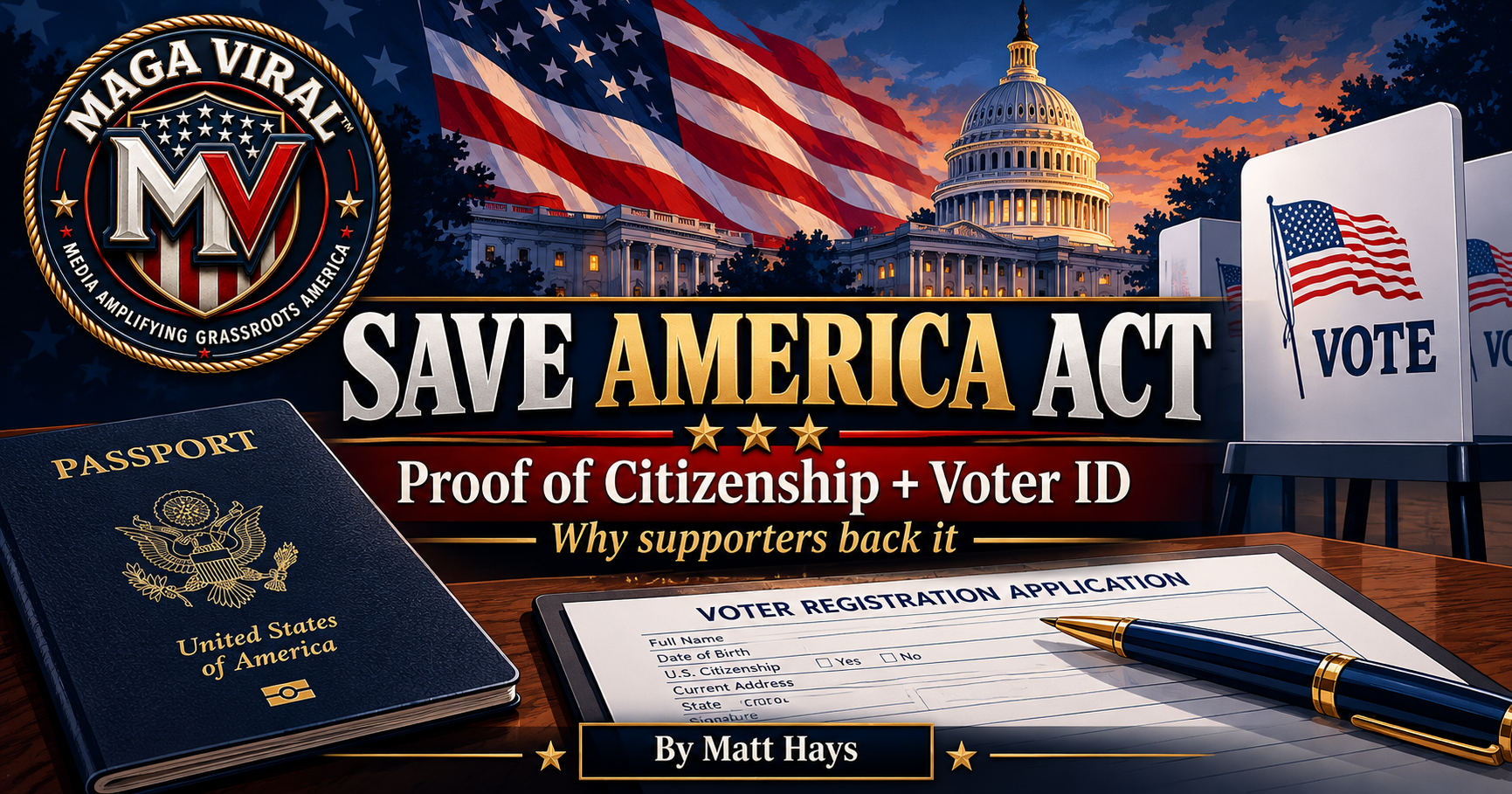
Supporters say the proposal would strengthen citizenship verification in federal elections, while critics warn the new documentation requirements could create barriers for eligible voters.
By Matt Hays | MAGA Viral™
The SAVE America Act remains at the center of a national debate over how federal elections should be administered.
The legislation would require people registering to vote in federal elections to provide documentary proof of U.S. citizenship. It would also establish a federal photo-identification requirement for casting a ballot.
The House passed the SAVE America Act language on February 11, 2026, by a vote of 218–213. The legislation subsequently encountered resistance in the Senate, where attempts to advance the proposal have fallen short of the votes required to move it forward.
As of September 23, 2026, the SAVE America Act has not become federal law.
What Would the SAVE America Act Change?
Federal law already prohibits noncitizens from voting in federal elections. The National Mail Voter Registration Form also requires applicants to indicate whether they are U.S. citizens and sign their application.
Supporters of the SAVE America Act argue that those safeguards should be strengthened through documentary verification.
Under the proposal, an individual registering to vote in a federal election would generally be required to provide documentation establishing U.S. citizenship. Acceptable documentation under the legislation includes certain REAL ID documents indicating citizenship, a valid U.S. passport and several other combinations of government identification and citizenship documents.
The proposal would also require eligible photo identification when a voter casts a ballot in a federal election.
What Happens if Someone Doesn't Have the Standard Documents?
One of the major issues in the debate has been what happens to eligible citizens who don't have readily available documentation.
The SAVE America Act directs states to establish an alternative process for applicants who cannot provide the standard documentary proof of citizenship.
Under that process, an applicant could sign an attestation under penalty of perjury and submit other evidence demonstrating U.S. citizenship. A state or local election official would then determine whether the applicant sufficiently established citizenship.
The legislation also addresses discrepancies between a person's current name and the name appearing on citizenship documents.
That issue has received particular attention involving married or divorced Americans whose current legal names may differ from the names on their birth certificates. The legislation directs states to establish procedures allowing additional documentation or an affidavit attesting that the name appearing on the citizenship document is a previous name of the applicant.
Exactly how those procedures would operate would depend partly on implementation by individual states and guidance from the U.S. Election Assistance Commission.
The Argument From Supporters
For supporters, the argument is straightforward: federal elections should be limited to eligible U.S. citizens, and they believe citizenship should be affirmatively verified during registration.
President Donald Trump and Republican lawmakers have repeatedly called for passage of the SAVE America Act, making proof of citizenship and voter identification major parts of their election-policy agenda.
Supporters argue that requiring documentation before registration and identification when voting would provide clearer verification of eligibility and increase public confidence in election administration.
They also point to the alternative procedures contained in the legislation as evidence that eligible citizens who lack standard documentation would still have a path to register.
What Critics Say
Opponents agree that noncitizens should not vote in federal elections but argue that the legislation could make registration more difficult for some eligible Americans.
Their concerns include people who do not have passports or readily accessible birth certificates, voters whose current names differ from their citizenship documents, and people who could face additional time or expense obtaining required records.
Critics also argue that documented instances of noncitizen voting are relatively uncommon and question whether the additional requirements are proportionate to the problem the legislation seeks to address.
Supporters dispute that the requirements would improperly exclude eligible voters and point to the bill's alternative verification and name-discrepancy provisions.
Where the Legislation Stands
The House approved the SAVE America Act language on February 11.
The Senate began considering the House message involving the legislation in March. On March 26, a cloture effort involving a SAVE Act voter-identification amendment failed 53–47, short of the 60 votes required.
Additional efforts to advance SAVE America Act provisions have also faced obstacles in the Senate. The proposal remained unpassed as Congress moved closer to the 2026 midterm elections.
The debate therefore remains unresolved.
For supporters, proof of citizenship and photo identification are reasonable safeguards for participation in federal elections.
For critics, the central question is whether those requirements would impose unnecessary burdens on eligible citizens.
Either way, the debate raises a fundamental election-policy question that Congress continues to confront: how should the government verify eligibility while ensuring qualified American citizens can exercise their right to vote?
Matt Hays is an independent creator contributing to MAGA Viral™.
Sources
U.S. House of Representatives — House passage of the SAVE America Act language, February 11, 2026.
U.S. Senate — Roll-call votes and floor activity concerning S. 1383 and SAVE America Act provisions, March 2026.
Congressional Research Service — Safeguard American Voter Eligibility Act (SAVE America Act) and Federal Voter Registration Policy and Law, updated February 24, 2026.
U.S. Election Assistance Commission — National Mail Voter Registration Form and voter-registration guidance.
U.S. Department of Justice — Federal law concerning noncitizen voting and federal election offenses.
FactCheck.org — Q&A on the SAVE America Act, March 2026.
White House — Administration statements and legislative materials concerning the SAVE America Act, 2026.
Have a local election story, community issue or news tip that deserves national attention? Submit your story to MAGA Viral™.