Sergeant Siwash: The Marine Duck Who Went to War, Fought a Rooster at Tarawa and Became a WWII Legend
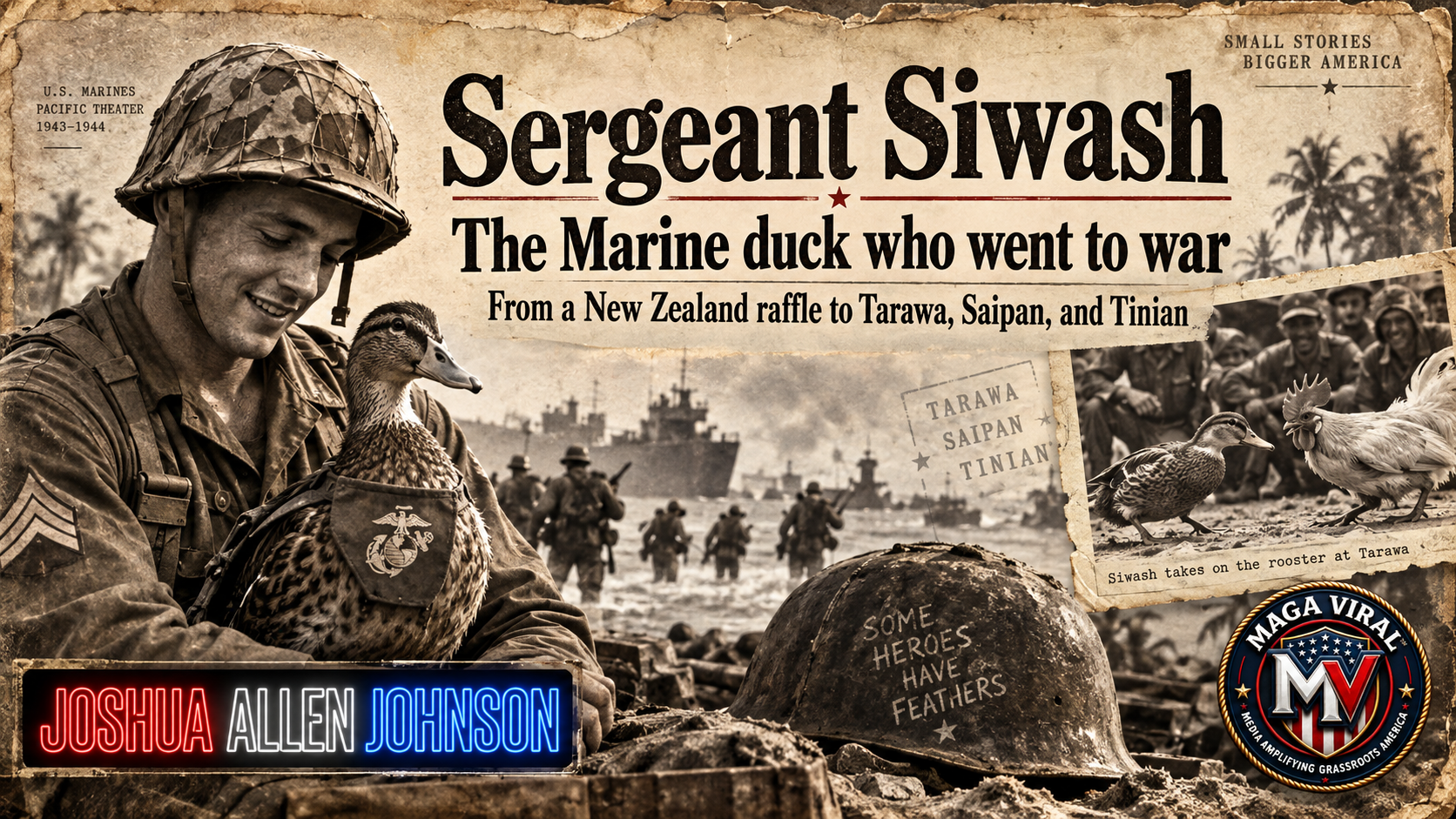
Won in a New Zealand raffle, Sergeant Siwash followed U.S. Marines into the Pacific, survived Tarawa, became famous for fighting an enemy rooster and earned a place in Marine Corps lore.
SERGEANT SIWASH: THE MARINE DUCK WHO WENT TO WAR
Some military stories sound exaggerated the moment you hear them.
A beer-drinking duck winning a combat citation after fighting a rooster during one of the bloodiest amphibious assaults of World War II sounds like one of them.
But Sergeant Siwash was real.
And behind decades of Marine Corps humor, newspaper stories and embellished retellings is the remarkable story of a duck that traveled across the Pacific with United States Marines, went ashore at Tarawa, accompanied them through three major campaigns and became one of the strangest mascots in American military history.
FROM A NEW ZEALAND RAFFLE TO THE MARINE CORPS
The story began in New Zealand in 1943.
Marine Francis “Pappy” Fagan won the duck in a raffle at a New Zealand pub while American forces were preparing for operations in the Pacific.
The bird was named Siwash, reportedly after Sergeant Jack “Siwash” Cornelius, another Marine. Siwash quickly became associated with Marines of the 1st Battalion, 10th Marines, an artillery unit of the 2nd Marine Division, and eventually became widely known as a mascot of the division.
There was another characteristic that helped Siwash fit in with the Marines.
The duck apparently liked beer.
Fagan later told reporters that Siwash would happily accept a drink but had standards. The duck reportedly preferred warm beer, the way it had been served in New Zealand, and would not touch draft beer.
The Marines initially believed Siwash was male. That assumption would survive into official stories, newspaper accounts and even the wording of the duck’s famous citation.
They eventually learned otherwise when Siwash began laying eggs.
TARAWA
On November 20, 1943, approximately 18,000 Marines began the assault on Tarawa Atoll in the Gilbert Islands.
The battle centered on Betio, a tiny, heavily fortified island defended by thousands of Japanese troops.
American landing forces encountered devastating machine-gun, artillery and rifle fire. Coral reefs prevented many landing craft from reaching the beach, forcing Marines to wade hundreds of yards through exposed water while under fire.
It became one of the most brutal battles of the Pacific War.
And somewhere in that chaos was Sergeant Siwash.
Accounts differ slightly on exactly how Siwash reached shore. One recollection described the duck being transported with an artillery piece before being released after reaching the island.
What happened afterward became Marine Corps legend.
Siwash encountered a rooster associated with the Japanese forces on Tarawa.
And apparently decided that this was now her war too.
According to the story repeated in Marine accounts and contemporary news coverage, the two birds fought.
Siwash was repeatedly pecked in the head but continued the fight.
Fagan later summarized the encounter rather simply:
“The rooster didn’t have a chance.”
The Marines memorialized the episode with a tongue-in-cheek but very real citation for bravery.
The citation praised Siwash for having “upon reaching the beach, without hesitation engaged the enemy in fierce combat.”
It went on to describe the enemy as a rooster, note Siwash’s wounds from repeated pecks and state that the duck refused medical attention until wounded Marines had been treated.
The joke worked because it was written in the language of an actual battlefield citation while describing a fight between two birds.
But there was no joke about the battle happening around them.
Thousands of Americans were killed or wounded during the three-day fight for Tarawa.
THE PURPLE HEART QUESTION
Over the years, Siwash has frequently been described as having received a Purple Heart for wounds suffered at Tarawa.
The surviving record is not completely consistent on that point.
Marine Corps Times reported that Marines considered awarding Siwash a Purple Heart but ultimately issued the famous bravery citation instead.
A 2022 article in Leatherneck, however, states that Lt. Col. Presley M. Rixey presented Siwash with both a Purple Heart and a commendation. At least one Marine veteran’s later recollection also said the men gave the duck a Purple Heart.
What is firmly documented is the bravery citation and the publicity surrounding Siwash’s wounds.
Whether the Purple Heart was formally awarded, informally presented by Marines or simply became part of the legend is less clear.
That ambiguity is part of Siwash’s story.
THE LEGEND GETS EVEN STRANGER
The rooster may not have been Siwash’s only animal encounter at Tarawa.
TIME magazine reported in January 1944 that the duck had also attacked and routed what the magazine described as a shell-shocked pig.
That episode appears far less consistently in later accounts than the rooster fight, but it shows just how quickly stories about Siwash were spreading during the war.
And there is another wrinkle.
Decades later, a story about Fagan’s retirement claimed he admitted that the famous rooster fight may not have unfolded quite as triumphantly as wartime reports suggested.
According to that later account, Fagan joked that the chicken had actually chased Siwash.
So what really happened on the beach?
A duck and a rooster unquestionably became the basis of a celebrated Marine Corps story almost immediately after Tarawa. Contemporary publications were already reporting it in 1943 and 1944.
Whether every feather of the legend survived intact is harder to prove.
That is probably exactly how Marine folklore is supposed to work.
SAIPAN AND TINIAN
Tarawa was not the end of Siwash’s Pacific tour.
The duck accompanied Marines during operations at Saipan and Tinian in 1944.
TIME reported that Siwash did not immediately reach the beach at Saipan. Later accounts describe the duck remaining aboard a destroyer while the battle unfolded.
At Tinian, however, Siwash was reportedly back in action.
TIME wrote in September 1944 that Siwash landed on D-Day and “personally captured” a tiny Japanese duck.
By then the bird had become a genuine wartime celebrity.
Tarawa.
Saipan.
Tinian.
Three names written into Marine Corps history, with one unlikely duck appearing alongside the Marines who fought there.
SIWASH COMES HOME
By late 1944, Siwash returned to the United States.
The homecoming received national attention.
LIFE magazine ran material on Siwash, and TIME reported on the returning Marine mascot. The duck appeared at public events, made radio appearances and was honored at a luncheon in Chicago.
Broadcaster Jack Brickhouse later remembered Siwash sitting in a small high chair at a Chicago event, drinking beer while prominent guests celebrated the returning mascot.
Siwash’s fame was also put to work.
Fagan and the duck participated in publicity and war-bond efforts.
For a time after World War II, Siwash reportedly lived on a farm in California.
When the Korean War began, the famous Marine duck was again used for recruiting and publicity before eventually settling at Chicago’s Lincoln Park Zoo.
A FEMALE MARINE DUCK
Throughout much of the war, Marines and reporters called Siwash “he.”
The famous bravery citation itself uses male pronouns.
Then came the eggs.
Siwash was female.
That discovery only added another chapter to the story of a mascot that had already managed to surprise practically everyone.
THE FINAL YEARS
Siwash spent her later years at Lincoln Park Zoo in Chicago.
In May 1954, the old Marine mascot died from a liver ailment.
And yes, the obvious joke was made.
Marine veterans insisted Siwash’s liver problems had nothing to do with her famous taste for beer.
There is even a small discrepancy over the exact date. Most later references give May 22, 1954, while a contemporary Camp Lejeune Globe report published shortly afterward said Siwash died May 26.
Either way, the death of a duck became Marine Corps news.
Siwash was preserved by a taxidermist, reportedly in a hurry because the famous mascot had been expected at a Marine reunion in San Diego.
The preserved duck was later donated to what became the National Museum of the Marine Corps.
But there is a final twist.
The museum later told the Chicago Tribune that the specimen deteriorated rapidly, possibly because of the hurried preservation process, and Siwash is no longer part of the museum’s collection.
THE MARINE CORPS NEVER REALLY FORGOT
Decades after Tarawa, the Marine Corps was still telling the story.
In 2018, the Corps released an official video titled “Sgt. Siwash | The Mighty Devil Duck.”
Its opening line captured the story perfectly:
Thousands of Marines charged the shores of Tarawa.
This Marine waddled.
Sergeant Siwash was not a combat Marine in the literal sense. She was a mascot, companion and morale booster whose exploits were told with the exaggerated humor Marines have carried through generations.
But she was there.
She traveled with Marines across the Pacific.
She went to Tarawa.
Her story appeared in wartime publications.
She received a citation for bravery.
And somewhere in the middle of one of the most violent battles of World War II, a Marine duck apparently decided there was one enemy rooster too many.
More than 80 years later, people are still telling the story.
That may be Sergeant Siwash’s greatest victory.
Semper Fi, Sergeant. 🦆🇺🇸
SOURCES:
• U.S. Marine Corps — “Sgt. Siwash | The Mighty Devil Duck,” Nov. 20, 2018
• Marine Corps Times — “The Marine who was a duck (yes, an actual duck),” Nov. 23, 2022
• TIME — “Army & Navy: Quack Hero,” Jan. 3, 1944
• TIME — “Marines: Good Old Siwash,” Sept. 25, 1944
• LIFE Magazine — Jan. 17, 1944, “Citation of ‘Siwash,’ the Marine Duck”
• National Museum of the Pacific War / UNT Libraries — archival U.S. Marine Corps photograph of Siwash, November 1943
• Leatherneck — June 2022, Marine Corps mascot history
• Camp Lejeune Globe — “Siwash, Famed Leatherneck Duck, Is Dead,” June 10, 1954
• Chicago Tribune archive — later reporting on Siwash’s death, preservation and museum history