If John F. Kennedy Were Alive Today, Would He Still Be a Democrat?
JFK’s record on patriotism, anti-communism, national strength and economic growth raises a revealing question about how much his party—and American politics—have changed.
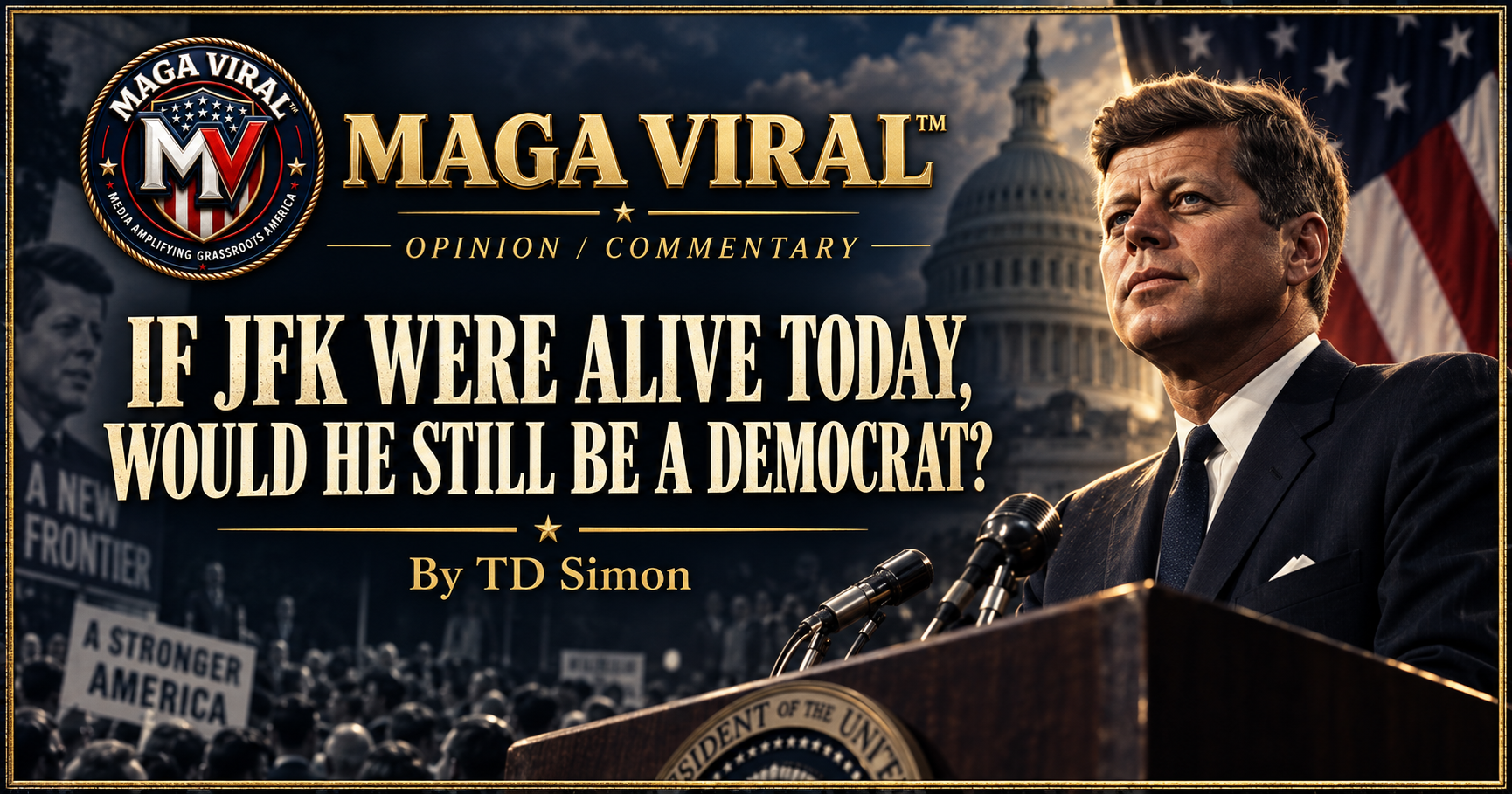
MAGA Viral opinion graphic featuring President John F. Kennedy at a podium with the U.S. Capitol and American flag, titled “If JFK Were Alive Today, Would He Still Be a Democrat?” by TD Simon.
There was a time when a Democratic president could speak openly about patriotism, personal responsibility, military strength, economic growth and the duty of every American to defend liberty.
John F. Kennedy did exactly that.
Kennedy was not a conservative by the standards of his own time, much less ours. He believed government had an important role in advancing civil rights, supporting education, investing in national projects and assisting Americans in need. He supported organized labor and called upon the federal government to confront problems that states had failed to resolve.
But Kennedy also represented a kind of Democratic politics that seems increasingly distant from the party we see today.
He spoke proudly about American exceptionalism. He confronted Soviet communism. He strengthened the nation’s defenses, promoted tax reductions to encourage economic growth and challenged Americans to ask what they could contribute to their country.
That raises an intriguing—and necessarily speculative—question:
If John F. Kennedy were alive today, would he still be a Democrat?
No historian, commentator or political party can answer that question with certainty. Kennedy died in 1963. He never confronted the political, cultural and economic conditions of 2026.
Still, examining what Kennedy actually said and did can reveal just how dramatically American politics has changed.
A CALL TO PERSONAL SACRIFICE
Kennedy’s inaugural address produced one of the most enduring statements in American political history:
“Ask not what your country can do for you—ask what you can do for your country.”
Those words were more than an attractive slogan. They expressed Kennedy’s belief that citizenship carried obligations as well as benefits.
He asked Americans to serve, sacrifice and participate in the defense of liberty. His administration created the Peace Corps, expanded the space program and urged a new generation to see public service as an honorable calling.
That message placed responsibility on the individual.
Government could organize national efforts, but the country’s future still depended upon the courage, discipline and participation of its people.
In a commemorative message issued on Roosevelt Day in January 1961, Kennedy described the United States as “a nation of minute men”—citizens prepared to defend freedom at a moment’s notice. He concluded:
“The cause of liberty, the cause of America, cannot succeed with any lesser effort.”
Kennedy understood that liberty survives only when citizens are willing to protect it.
Today, Americans hear far more political discussion about what government owes them than about what they owe their country. Benefits and entitlements dominate many debates, while service, sacrifice and personal responsibility often receive less attention.
Kennedy would likely recognize the legitimate role of government in helping people overcome hardship. His own record makes that clear. But he would also remind Americans that citizenship cannot be reduced to receiving assistance.
A free nation requires citizens who are prepared to contribute.
AN UNAPOLOGETIC OPPONENT OF COMMUNISM
Kennedy assumed the presidency during one of the most dangerous periods of the Cold War.
The Soviet Union was expanding its influence. Communist regimes were consolidating power. Nuclear confrontation was a constant possibility.
Kennedy did not treat communism as merely another political system with which America happened to disagree. He recognized it as an authoritarian ideology that had crushed political opposition, restricted religious liberty and denied fundamental individual rights wherever it obtained absolute power.
His administration confronted Soviet pressure in Berlin, navigated the Cuban Missile Crisis and continued the broader American effort to contain communist expansion.
Speaking in West Berlin in June 1963, Kennedy declared that freedom had difficulties and democracy was not perfect—but that democratic nations never needed to construct walls to prevent their people from leaving.
It was a direct moral challenge to Soviet authoritarianism.
Modern democratic socialism is not identical to Soviet communism, and honest political debate should not pretend otherwise. Contemporary policy proposals must be evaluated on their own merits.
Nevertheless, Kennedy would almost certainly scrutinize any movement that concentrated excessive power in government, weakened private enterprise or encouraged Americans to surrender personal responsibility to a permanent political bureaucracy.
He had seen where unchecked state power could lead.
Would Kennedy be comfortable with influential figures openly promoting socialism inside the Democratic coalition?
Would he believe the party was adequately distinguishing social assistance from government dependency?
Those questions deserve serious consideration.
PEACE THROUGH NATIONAL STRENGTH
Kennedy is often remembered for his vision and eloquence, but his presidency unfolded against the threat of nuclear war.
His inaugural address warned America’s adversaries that the United States would “pay any price” and “bear any burden” to ensure the survival and success of liberty.
Those were not the words of a leader who believed weakness would produce peace.
Kennedy increased defense spending, strengthened America’s conventional military capacity and supported the expansion of its strategic forces. He understood that diplomacy is most effective when adversaries respect the strength behind it.
His handling of the Cuban Missile Crisis demonstrated that balance. Kennedy resisted both reckless escalation and passive submission. He combined military preparedness, measured judgment and direct diplomacy to force the removal of Soviet nuclear missiles from Cuba.
That episode did not prove that every international crisis requires military intervention. It proved that credible strength gives a president options.
Kennedy wanted peace, but he did not confuse peace with retreat.
In today’s political environment, he would probably reject both endless, poorly defined military commitments and the belief that America can remain secure by appearing unwilling to defend itself or its allies.
A strong military is not valuable because Americans desire war.
It is valuable because strength can help prevent war.
KENNEDY AND ECONOMIC GROWTH
Kennedy also departed from the stereotype that every social problem could be solved by continuously raising tax rates.
In a 1962 address to the Economic Club of New York, he argued that the country needed to remove unnecessary restraints on private purchasing power and investment. He advocated broad reductions in individual and corporate income-tax rates to promote economic expansion.
The major legislation inspired by that proposal became the Revenue Act of 1964, which Congress enacted after Kennedy’s assassination.
That distinction matters: Kennedy proposed and promoted the policy, but he did not live to sign the final law.
His reasoning nevertheless remains instructive. Kennedy believed that excessively high tax rates could restrict investment, weaken incentives and slow the broader economy.
He was not arguing that government had no responsibilities. His administration supported federal investment in defense, infrastructure, science, education and the space program.
He was arguing that government could not redistribute prosperity that the private economy had failed to create.
That principle seems almost foreign to some areas of modern progressive politics, where taxation is frequently presented not only as a means of funding necessary services but as an instrument for reshaping economic outcomes.
Kennedy’s approach was different.
He believed economic growth, private investment and national purpose could reinforce one another.
PATRIOTISM WITHOUT APOLOGY
Kennedy spoke about America with confidence.
He acknowledged the nation’s failures and believed the country had an obligation to correct them. His 1963 civil-rights address described racial discrimination as a moral crisis and called upon Congress to act.
That was not a rejection of America.
It was an appeal for America to live more fully according to its own founding principles.
Kennedy’s patriotism was neither blind nor ashamed. He could recognize injustice while still believing the United States represented an extraordinary experiment in human freedom.
That balance is badly needed today.
Americans should be honest about their country’s failures. Slavery, segregation, discrimination and other injustices are part of our national history. Refusing to acknowledge them would be dishonest.
But acknowledging injustice is not the same as teaching Americans that their nation is fundamentally irredeemable.
Kennedy believed the American promise was worth preserving precisely because it was worth perfecting.
He would probably find little wisdom in a politics that treats the flag with suspicion, regards national pride as embarrassing or describes the country principally through its worst chapters.
America’s imperfections did not invalidate its ideals.
They made fulfilling those ideals more urgent.
THE PARTIES HAVE BOTH CHANGED
It would be historically careless to transplant Kennedy directly into modern politics and simply declare him a Republican.
The Republican Party of 2026 is not the Republican Party Kennedy opposed. The Democratic Party is not the party he led. Both coalitions have changed, and the ideological distance between them has grown.
Kennedy supported an active federal government, labor unions, public investment, civil-rights legislation and a social safety net. On several issues, he would remain more comfortable with Democrats than with today’s Republicans.
On other questions—patriotism, anti-communism, military strength, public order, personal responsibility and tax policy—his language might sound more familiar to many modern conservatives.
This tension is precisely what makes the question valuable.
Research on political polarization shows that Democrats and Republicans have grown further apart ideologically, while their voter coalitions have undergone profound changes. Education, geography, religion, race and class now divide the parties differently than they did during Kennedy’s lifetime.
Therefore, the honest question is not whether every Kennedy policy fits comfortably into one modern platform.
It is whether the political philosophy that tied those policies together still has a secure home inside his party.
WHAT WOULD KENNEDY RECOGNIZE?
Would Kennedy recognize a Democratic Party in which self-described democratic socialists exercise significant influence?
Would he accept political rhetoric that treats law enforcement primarily as a source of oppression rather than an institution that requires both accountability and public support?
Would he embrace an open-ended expansion of federal authority?
Would he approve of a culture that too often measures citizenship by what people can demand instead of what they are prepared to contribute?
Would he recognize a party whose most progressive voices can appear uncomfortable with traditional patriotism?
These questions should not be confused with definitive answers.
Kennedy was a complex political leader, not a collection of quotations available for adoption by either modern party. He adapted to circumstances, changed positions and governed pragmatically.
Had he lived, his views might also have evolved.
But his public record reveals several durable convictions:
America was worth defending.
Communism was a threat to human freedom.
Military strength helped preserve peace.
Economic growth required a productive private sector.
Government had important responsibilities, but citizens did too.
National service was honorable.
Civil rights were inseparable from the American promise.
These principles do not fit perfectly within either political party today.
Perhaps that is the point.
A PARTY MOVING AWAY FROM KENNEDY
The Democratic Party still celebrates John F. Kennedy as one of its defining modern presidents.
It invokes his name, displays his image and quotes his inaugural address. But honoring a political leader requires more than preserving his words.
It requires confronting what those words meant.
Kennedy did not ask Americans to become passive recipients of government action. He asked them to serve.
He did not treat America’s power as inherently corrupt. He believed it could be used to defend liberty.
He did not answer economic stagnation by demanding permanently higher tax rates. He sought to release private investment and encourage growth.
He did not respond to America’s failures by abandoning patriotism. He challenged the country to fulfill its principles.
Would John F. Kennedy still be a Democrat today?
We cannot know.
Perhaps he would remain and attempt to pull the party back toward the confident liberalism of his generation. Perhaps he would become politically homeless. Perhaps he would conclude that the party carrying his name and legacy had moved too far from the principles he considered essential.
The answer belongs to history’s unknowable possibilities.
The more important question belongs to the Democratic Party itself:
Has it remained faithful to Kennedy’s vision—or has it simply continued displaying his portrait while moving away from what he believed?
SOURCES AND FURTHER READING
John F. Kennedy Presidential Library and Museum, “President Kennedy’s Commemorative Message on Roosevelt Day,” January 29, 1961.
National Archives, “President John F. Kennedy’s Inaugural Address,” January 20, 1961.
John F. Kennedy Presidential Library and Museum, “Remarks at the Rudolph Wilde Platz, Berlin,” June 26, 1963.
John F. Kennedy Presidential Library and Museum, materials concerning the Cuban Missile Crisis.
John F. Kennedy, “Address and Question-and-Answer Period at the Economic Club of New York,” December 14, 1962.
Economic Report of the President, January 1963.
John F. Kennedy Presidential Library and Museum, “Radio and Television Report to the American People on Civil Rights,” June 11, 1963.
Pew Research Center, “Political Polarization in the American Public,” June 12, 2014.
Pew Research Center, “Changing Partisan Coalitions in a Politically Divided Nation,” April 9, 2024.
Victor Davis Hanson, contemporary political commentary concerning the Democratic Party, September 2026. This source reflects Hanson’s opinion and is not used as evidence for Kennedy’s historical record.